

What is Artificial Intelligence?
Definition: It's (really smart) software

Welcome to definition #1 of the AI Dictionary Detail(ed) series. This primer defines artificial intelligence.
When I approach technology as a research analyst, I like to provide context, and first ask whether we are discussing hardware, software, or an application. When I began exploring artificial intelligence, I encountered descriptions that touched on all these possibilities. While these definitions weren't inaccurate, they were just unclear enough that I didn’t feel I fully understood artificial intelligence.
Consider a few AI definitions
IBM writes on its website, “Artificial intelligence, or AI, is technology that enables computers and machines to simulate human intelligence and problem-solving capabilities.” To me, that sounds like AI involves hardware, but how do you “simulate human intelligence?”
The International Standards Organization describes AI as “a technical and scientific field devoted to the engineered system that generates outputs such as content, forecasts, recommendations or decisions for a given set of human-defined objectives.” This definition is precise, and an “engineered system” may refer to software, but it’s a lot to unpack.
Andrew Ng, of DeepLearning.ai, presents this AI description under the title, “Demystifying AI” in an introductory Coursera course called “AI for Everyone.”
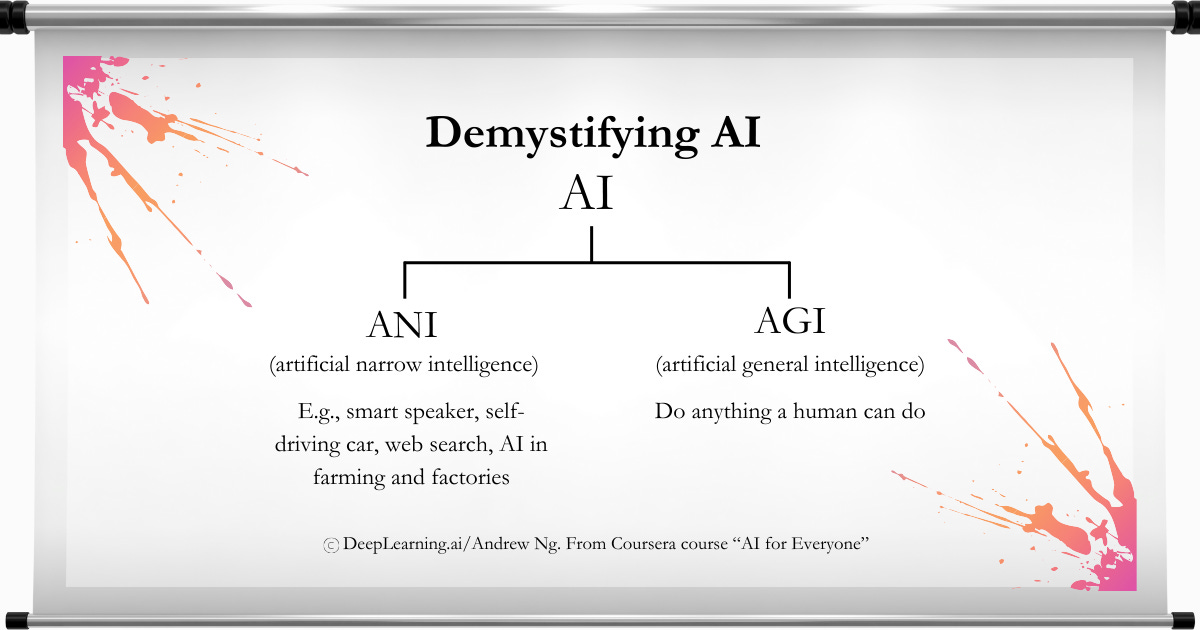
"Demystified" may not describe my takeaway here, but according to this definition, when AI is artificial narrow intelligence (ANI), it’s an application. When AI means artificial general intelligence (AGI), it implies that AI can perform any task a human can. That’s a bold assertion but also unrealistic—giving birth is in the AI repertoire? I don't think so.
Quick Aside: Since we've just touched on the idea that AI is human-like, I remain skeptical of the notion of AI surpassing humanity. Anthropomorphizing AI can overstate the technology’s capabilities and potentially exaggerate its abilities.
The parts of artificial intelligence
Although there are many definitions of AI, I still wanted to answer my initial question. So, I analyzed the definitions to reach a clear understanding. I learned that artificial intelligence is not an island and involves elements of hardware, software, and applications. For example, Siri is an application based on AI software that generates human-like responses from Apple hardware. Let’s break that down.
Siri as AI application (resembling human intelligence)
Siri, an AI-based application, resembles human intelligence in several ways. It understands and analyzes spoken language. It performs a variety of tasks (generates output) like setting reminders, answering factual questions, or translating languages. It learns from user interactions and improves its responses by adapting to your speech patterns and preferences. It decides the best way to answer questions by analyzing the content of the spoken commands.
Siri as AI-software
Siri’s AI software uses advanced natural language processing to understand and generate human language and machine learning to improve over time. (I’ll define these terms in upcoming primers). For now, when AI is said to "simulate human intelligence," we are referring to these software features. In Siri’s case, the application “sounds” human and learns on its own.
Siri as AI-hardware
The hardware that Siri relies on includes such components as processors, microphones, and internet connectivity. While Siri relies on these components to run computations and capture speech, the core of its intelligence is the software.
What is artificial intelligence?
To understand AI, we need to recognize all its parts, but here is my brief definition, adding to the many others that exist:
Artificial intelligence is a technology that can perform tasks that we typically associate with human intelligence, such as learning or decision-making. This technology combines sophisticated software and high-performance hardware to carry out these actions. However, software is the heart of AI.
This primer primarily defines artificial intelligence as software. The definition will explain AI coding elements, its unique programming, the special software training, and the data used in training the software. It also explains why this software is called "artificial intelligence."
What makes AI software unique?
AI's complex software consists of extensive computer code, mathematical models, and vast information sources known as data or input. Essentially, we can think of AI as a series of steps: input → computer programming → output, as shown in the graphic below. AI software, though, is unique in each of these steps. The input is vast, the programming can self-teach, and the output is intelligible.
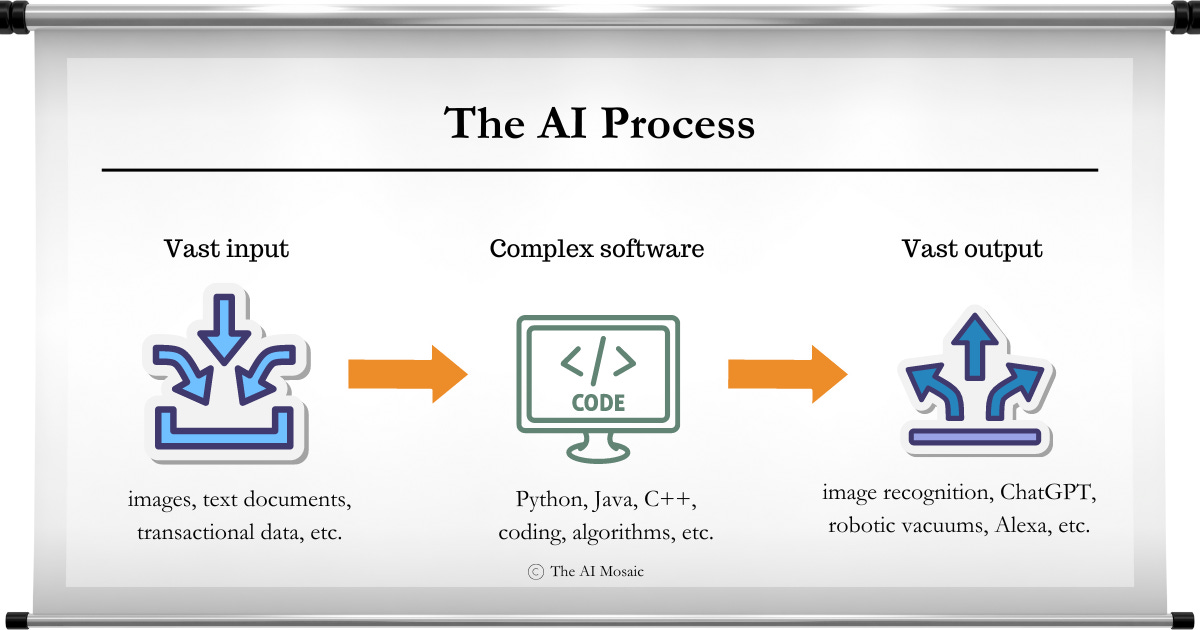
The Siri example showed how AI applications generate output that imitates human thought processes. The software feature called machine learning enables AI software to learn, improve, and adapt without additional coding instructions. Siri learns from your patterns, improves its responses, and adapts to your preferences. Its software figures you out on its own, so to speak.
In contrast, traditional software follows explicit instructions from programmers and never deviates from them. For example, a traditional email spam filter flags emails based on fixed criteria set by its programmers. An AI-powered spam filter, however, can learn from new spam patterns and adapt its filtering criteria without additional programming.
AI’s vast input: lots of information
To illustrate this learning process, let's consider an example of AI's vast input. Imagine designing an AI model to identify images of flowers. By integrating this program into an app, nature enthusiasts can identify flowers by taking photos and uploading them, with the AI-powered app providing the flower's name.
The initial flower model (or software) is written and trained on a dataset of various flower images (the input). After exposure to many examples, the AI model learns the characteristics of flowers. This training involves making the flower images computer-friendly and fine-tuning the code to enable flower recognition as the software learns from and processes these images. (A separate primer covering the many types of “input” referred to as datasets and training data is in the works.)
Here is a picture of a sample dataset of flower images that an AI model might learn from:
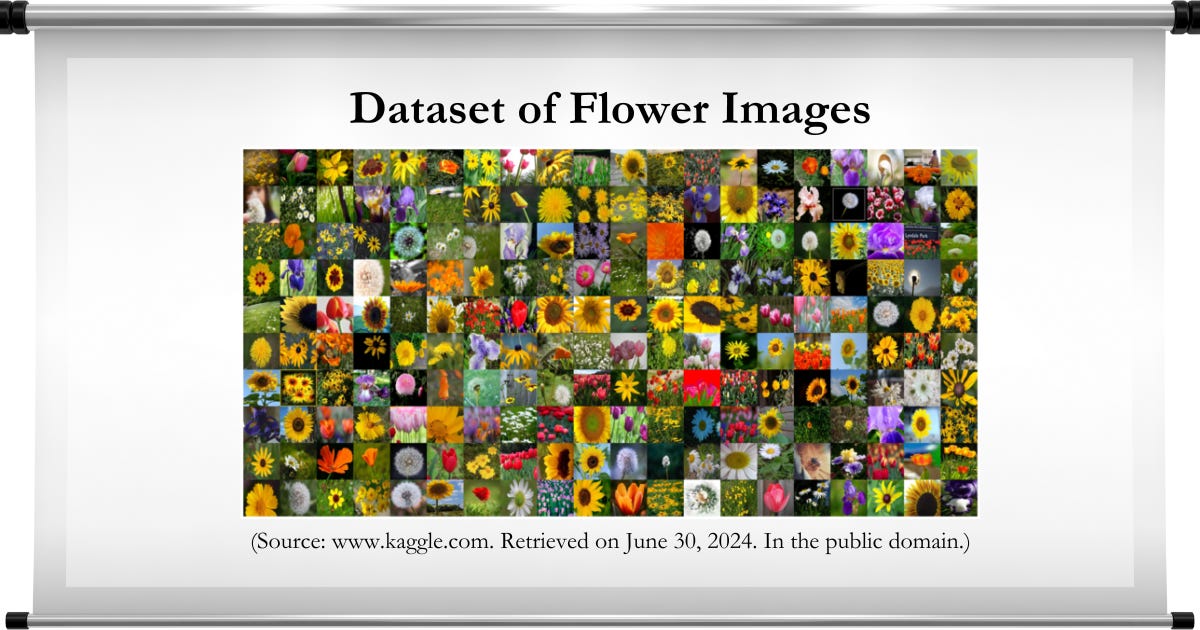
The complex AI software is unique because, after being exposed to many images of flowers, it can recognize that a tree is not a flower without needing training on tree images. The code’s ability to extrapolate from what the AI model has been trained on (flower images) to what it hasn’t yet been taught (tree images) is what gives AI its “intelligence.” Hence, artificial intelligence. This is the same experience as AI-enabled spam filters that can identify new spam without specific training on the new spam’s content or structure.
Quick aside: Even after extensive training, AI can make mistakes. For example, it might identify a tattoo of a flower as an actual flower. The fact that AI software can learn to recognize flowers and distinguish them from trees is impressive, but it doesn't mean that AI will surpass humanity. I can also report that my spam filter fails a lot.
AI software: lots of code and algorithms
The code
Besides the rigorous input training, AI software comprises intricate code and algorithms. This code, written in programming languages like Python, R, Java, and C++, provides detailed instructions allowing an AI program to process data (information) and perform tasks. For instance, when an AI-based application like Gmail helps you filter and organize your emails, the code analyzes your email habits and preferences to categorize incoming messages.
AI code also includes protocols. These rules and standards for communication define how different parts of the software interact and process the data. For example, a protocol might require encrypting financial data to ensure privacy and security before the online banking app transmits it to the bank's server.
What does code look like?
The image below displays a mock Python code example that uses AI to predict movie satisfaction. It also includes a linear regression algorithm. Imagine that this sample code is for an application that predicts viewer satisfaction with the movies they watched over the previous month.
In this example, the satisfaction rating is based on viewers' previously watched action and comedy movies. Streaming services can use this information to decide what new content to acquire. For instance, if users show high satisfaction with action and comedy movies, the service might prioritize acquiring more content in those genres to keep users engaged.
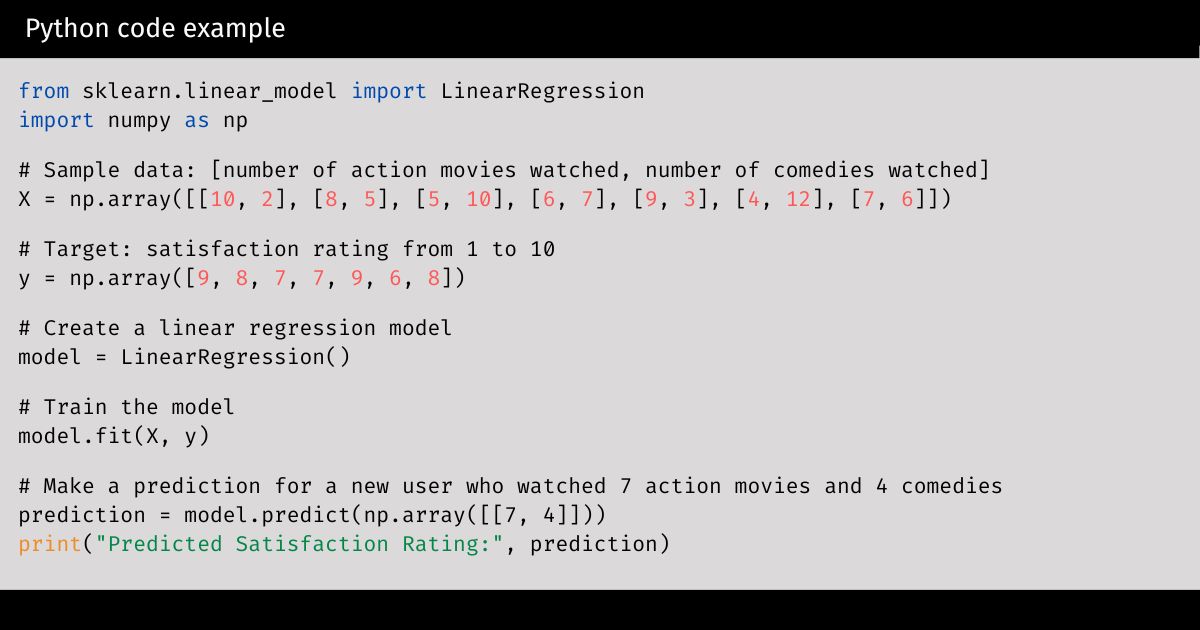
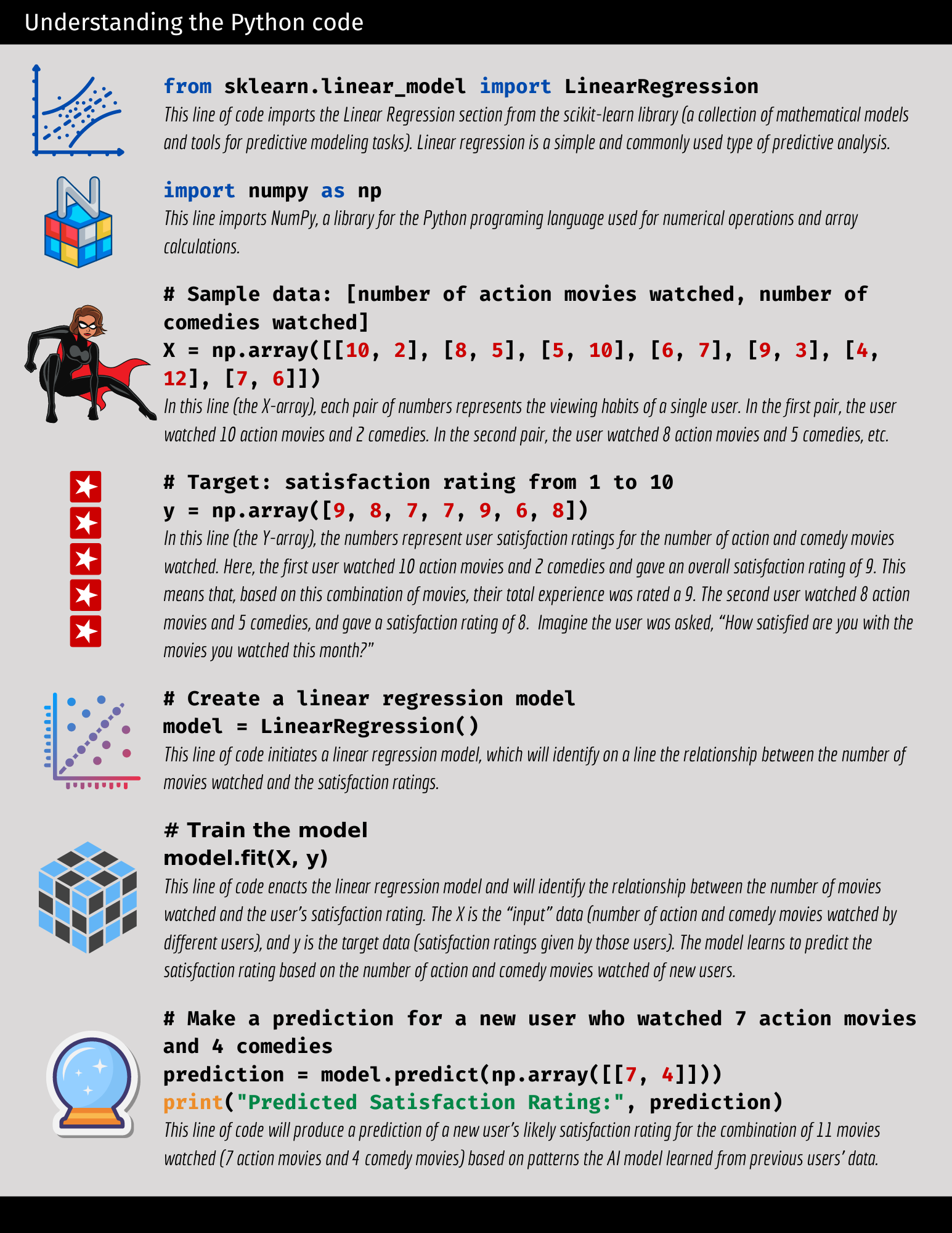
Although the code may be unintelligible without a knowledge of Python, the image provides a glimpse of a simplified snippet of computer code used in artificial intelligence. You may notice there are lines in the program that begin with the pound or hashtag symbol. These lines are not actual code to perform a function. Instead, they serve as descriptive titles that explain, in simple terms, the purpose of the code below.
The graphic below explains the meaning of each line of code in the Python example:
The algorithm
AI-based software also relies on algorithms to manage the data and perform tasks. (A separate primer on algorithms if forthcoming.) These algorithms generate instructions that guide the computer in carrying out particular tasks. In our daily lives, many of us experience the “algorithm factor” without ever seeing the calculation that’s running behind the scenes.
When job hunting, we tweak our applications to outsmart the algorithm and reach a human. Unfortunately, it’s not always straightforward to trick the algorithms with so many at play in the background. The graphic below highlights just three of the algorithms used in a job search platform: keyword matching, clustering, and pattern recognition.
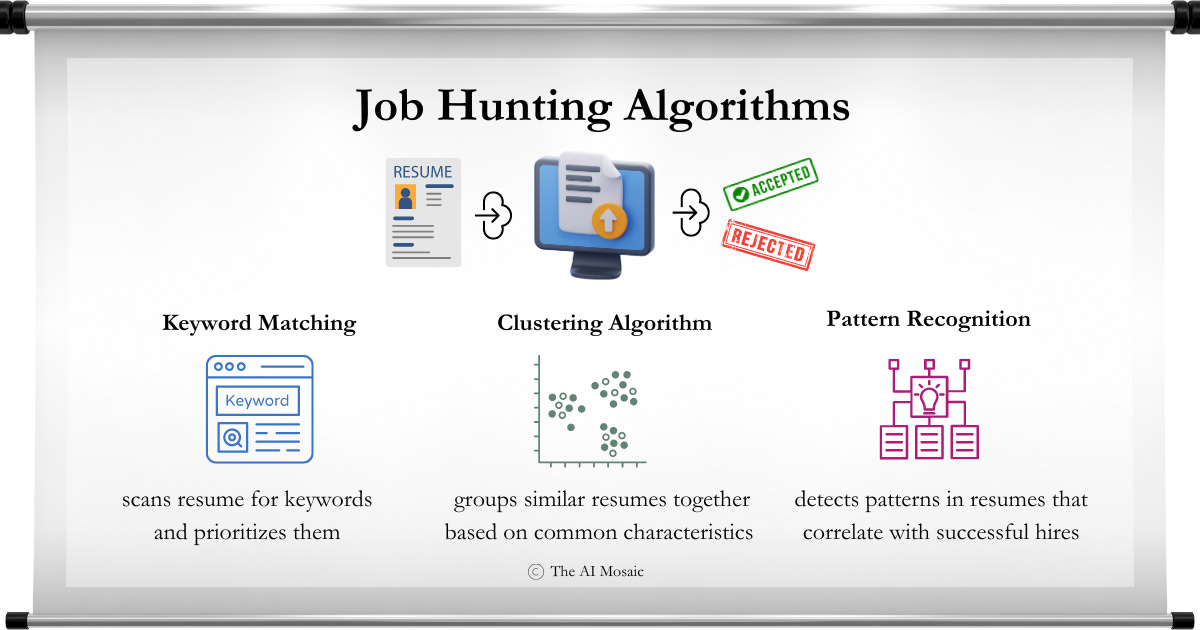
As you can see, algorithms play a pivotal role in our interactions with AI-based systems.
Conclusion: the humanity in AI
In sum, this article explored how AI mimics human intelligence by exploring the contours of the technology. It highlighted the software’s uniqueness from its specialized training, self-teaching abilities, and complex programming. Hopefully, such real-world examples like Siri, spam filters, and online job applications made the abstract more tangible and understandable.
Significant disruptions to society tend to produce discomfort and fear. Artificial intelligence is one of those disruptions. Just like Twain’s death, however, AI’s threat to humanity is greatly exaggerated. While its capabilities are impressive and sometimes concerning, let’s not forget that AI remains a human-driven technology. It depends on an extensive corpus of human content to train the software, specialized human programmers, and continual human expertise and oversight to bring it to fruition.
Embracing AI’s capabilities and harnessing them to your advantage is a more productive approach than ignoring or challenging AI’s clear arrival in our lives. In the end, AI is just as much about the human experience as it is about the software and hardware that power it.